ASCE 7-22 Seismic Wall Anchorage |
  
|
ASCE 7-22 Seismic Wall Anchorage |
|
This module calculates the seismic out-of-plane forces on structural walls and the anchorage forces required to connect walls to the roof or floor diaphragm, in accordance with ASCE 7-22 Section 12.11. Input parameters are taken directly from the nomenclature presented in ASCE 7.
Two results are produced:
1.Out-of-Plane Force for Structural Wall Design: The distributed force (psf) used to design the wall itself for out-of-plane bending (ASCE 7-22 Section 12.11.1)
2.Out-of-Plane Wall Anchorage Force: The total anchorage force (lbs) at a single anchor point connecting the wall to the diaphragm (ASCE 7-22 Section 12.11.2)
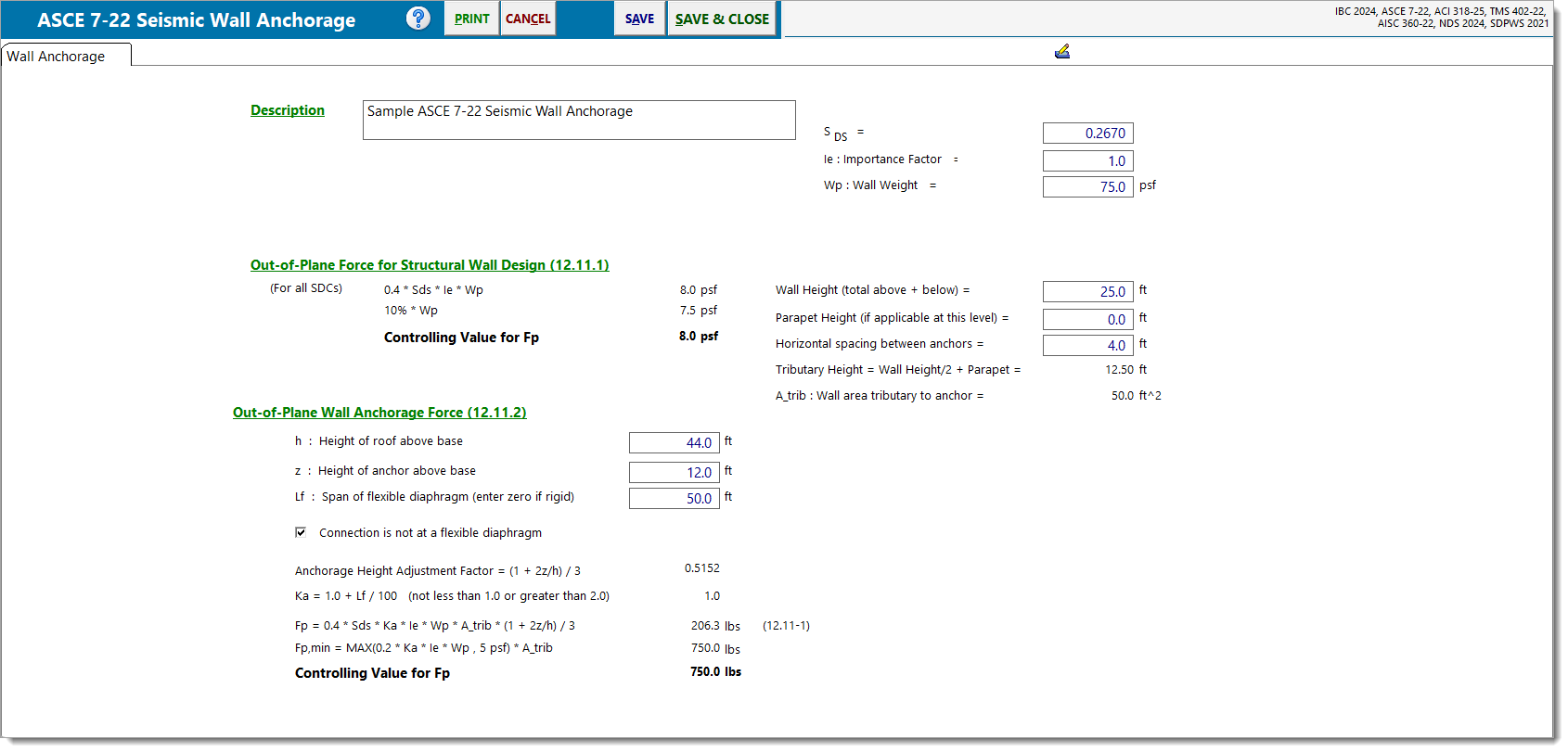
Sds: Design spectral response acceleration at short periods.
Ie : Importance Factor: Seismic importance factor, based on Risk Category.
Wp : Wall Weight: Weight of the wall per unit area.
Wall Height: Total height of the wall above and below the anchor level. Half of this value is used to compute tributary height.
Parapet Height: Height of parapet above this level, if applicable. Added to half the wall height to get tributary height.
Horizontal spacing between anchors: Center-to-center distance between wall anchors along the wall length.
Tributary Height: Total height tributary to the anchor, taken as Wall Height / 2 + Parapet Height
A_trib: Total wall area tributary per anchor is, taken as Tributary Height * Horizontal spacing between anchors
Out-of-Plane Force for Structural Wall Design (12.11.1)
Determines the minimum distributed force (psf) for wall panel design. Applies to all Seismic Design Categories.
The force is the greater of:
•Fp = 0.4 * Sds * Ie * Wp
•Fp,min = 0.10 * Wp
Out-of-Plane Wall Anchorage Force (12.11.2)
Calculates the total anchorage force (lbs) at a single anchor connecting the wall to the diaphragm.
h : Height of the roof above base: The height of the roof above the base of the building.
z : Height of the anchor above the base: The height of the anchor above the base. For a roof-level anchor, z = h.
Lf : Span of flexible diaphragm: Span of the flexible diaphragm providing lateral support. Enter zero for a rigid diaphragm.
Connection is not at a flexible diaphragm: Check this box when the anchorage is not at a flexible diaphragm level. This affects the height adjustment factor and the upper limit on Ka.
Anchorage Height Adjustment Factor: When the connection is not at a flexible diaphragm, the force is multiplied by a factor of (1 + 2z/h) / 3. When the connection is at a flexible diaphragm, the adjustment factor is 1.0.
Ka: Amplification factor for diaphragm flexibility, taken as Ka = 1.0 + Lf / 100, but not less than 1.0 and not greater than 2.0. If the connection is not at a flexible diaphragm, Ka = 1.0
The anchorage force is the greater of:
•Fp = 0.4 * Sds * Ka * Ie * Wp * A_trib * [Anchorage Height Adjustment Factor (if applicable)]
•Fp,min = MAX( 0.2 * Ka * Ie * Wp , 5 psf ) * A_trib
 <
<