Calculation of Soil Pressures |
  
|
Calculation of Soil Pressures |
|
Last revised: Friday, May 8, 2026 at 12:05 PM
Two settings control how bearing pressure is computed:
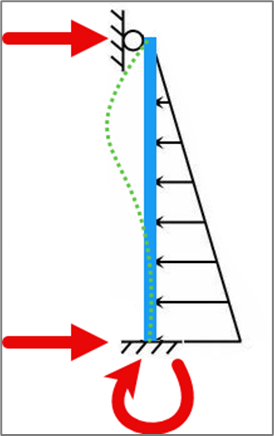
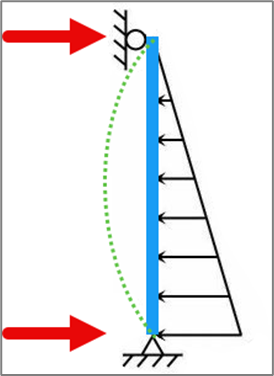
•Stem Base Fixed to Footing (General tab): Checked = Fixed, Unchecked = Pinned
•Slab is present to resist all sliding forces (Footing tab): Checked = Yes, Unchecked = No
These produce four permutations that affect how the Overturning Moment (OTM) and Resisting Moment (RSM) are computed about the toe of the footing, which in turn determine eccentricity and the resulting soil pressure distribution.
|
Slab is present to resist all sliding forces? |
|
Stem base is fixed? |
Yes |
No |
Yes
|
Effect of Eccentric Vertical Loads Contributes to nonuniform soil pressure distribution. Eccentricities toward the toe cause higher pressure at the toe, lower at the heel; eccentricities toward the heel have the opposite effect.
Effect of Applied Moment from Stem Contributes to nonuniform soil pressure distribution - higher pressure at the toe, lower at the heel.
Effect of Applied Shear from Stem Fully resisted by the slab. |
Effect of Eccentric Vertical Loads Contributes to nonuniform soil pressure distribution. Eccentricities toward the toe cause higher pressure at the toe, lower at the heel; eccentricities toward the heel have the opposite effect.
Effect of Applied Moment from Stem Contributes to nonuniform soil pressure distribution - higher pressure at the toe, lower at the heel.
Effect of Applied Shear from Stem Contributes to sliding and introduces nonuniform soil pressure due to eccentricity from the base - higher pressure at the toe, lower at the heel. |
No
|
Effect of Eccentric Vertical Loads Contributes to nonuniform soil pressure distribution. Eccentricities toward the toe cause higher pressure at the toe, lower at the heel; eccentricities toward the heel have the opposite effect.
Effect of Applied Moment from Stem No additional moment is present as the stem base is pinned.
Effect of Applied Shear from Stem Fully resisted by the slab. |
Effect of Eccentric Vertical Loads Contributes to nonuniform soil pressure distribution. Eccentricities toward the toe cause higher pressure at the toe, lower at the heel; eccentricities toward the heel have the opposite effect.
Effect of Applied Moment from Stem No additional moment is present as the stem base is pinned.
Effect of Applied Shear from Stem Contributes to sliding and introduces nonuniform soil pressure due to eccentricity from the base - higher pressure at the toe, lower at the heel. |
RSM is the sum of all clockwise (stabilizing) moments about the toe produced by vertical loads:
RSM = (soil weight on heel * arm to toe)
+ (surcharge on heel * arm to toe)
+ (footing self-weight * arm to toe)
+ (stem self-weight * arm to toe)
+ (axial load on stem * arm to toe)
+ (soil weight on toe * arm to toe)
+ (surcharge on toe * arm to toe)
+ (adjacent footing weight * arm to toe)
Each component is the vertical force multiplied by its horizontal distance (moment arm) from the toe.
OTM represents the counterclockwise (destabilizing) moments about the toe. Its composition depends on both stem fixity and whether a slab is present:
•Stem Pinned, No Slab: OTM = Moment due to stem shear + Lateral earth pressure moment on footing
•Stem Pinned, Slab Present: OTM = 0
•Stem Fixed, No Slab: OTM = Moment due to stem shear + Moment due to stem fixed-end moment + Lateral earth pressure moment on footing
•Fixed, Slab Present: OTM = Moment due to stem fixed-end moment
Here are detailed descriptions for each component:
•Moment due to stem shear: The horizontal shear from the stem acts at the top of the footing. Its moment about the toe equals the shear force * the footing thickness.
•Moment due to stem fixed-end moment: The bending moment at the base of the stem when it is fixed to the footing. The reaction on the footing is equal and opposite to the moment on the stem, tending to push the toe down and the heel up.
•Lateral earth pressure moment on footing: Soil pressure acts horizontally on the heel face of the footing itself (below the base of the stem). This includes contributions from retained soil above, the increasing pressure with depth, and surcharge.
When a slab is present, it is assumed to resist all lateral (horizontal) forces at the base of the wall. The shear from the stem and the earth pressure on the footing depth are resisted by the slab rather than being transferred to the soil beneath the footing. These forces no longer contribute to overturning.
However, the fixed-end moment is a moment, not a lateral force. The slab does not resist it, so when the stem is fixed, the fixed-end moment always contributes to OTM regardless of slab presence.
When the stem is pinned and a slab is present, the pinned connection produces no moment at the stem base, and the slab absorbs all lateral forces. There is nothing left to overturn the footing, thus OTM = 0.
A single formula applies to all four permutations:
eccentricity = (footing width / 2) − (RSM + OTM) / P
Where:
•P is the total vertical load on the footing.
•RSM is the total resisting moment about the toe (clockwise = stabilizing = positive)
•OTM is the total overturning moment about the toe (counterclockwise = destabilizing = negative)
(RSM + OTM) / P gives the distance from the toe to the line of action of the resultant vertical load. Subtracting from half the footing width gives the offset of the resultant from the footing centroid.
•A positive eccentricity means the resultant is toward the toe, thus producing higher pressure at the toe.
•A negative eccentricity means the resultant is toward the heel, thus producing higher pressure at the heel.
The eccentricity and total vertical load determine the bearing pressure distribution. The critical threshold is the kern distance (footing width / 6):
Within the kern (|eccentricity| ≤ footing width / 6):
Trapezoidal distribution, full contact:
•Max Pressure = (P / footing width) * (1 + 6 * |eccentricity| / footing width)
•Min Pressure = (P / footing width) * (1 − 6 * |eccentricity| / footing width)
Outside the kern (|eccentricity| > footing width / 6):
Triangular distribution, partial uplift:
•Max Pressure = 2P / (3 * (footing width / 2 − |eccentricity|))
•Min Pressure = 0
For a typical retaining wall, the resultant shifts toward the toe due to lateral earth pressures, producing the highest bearing pressure at the toe.